
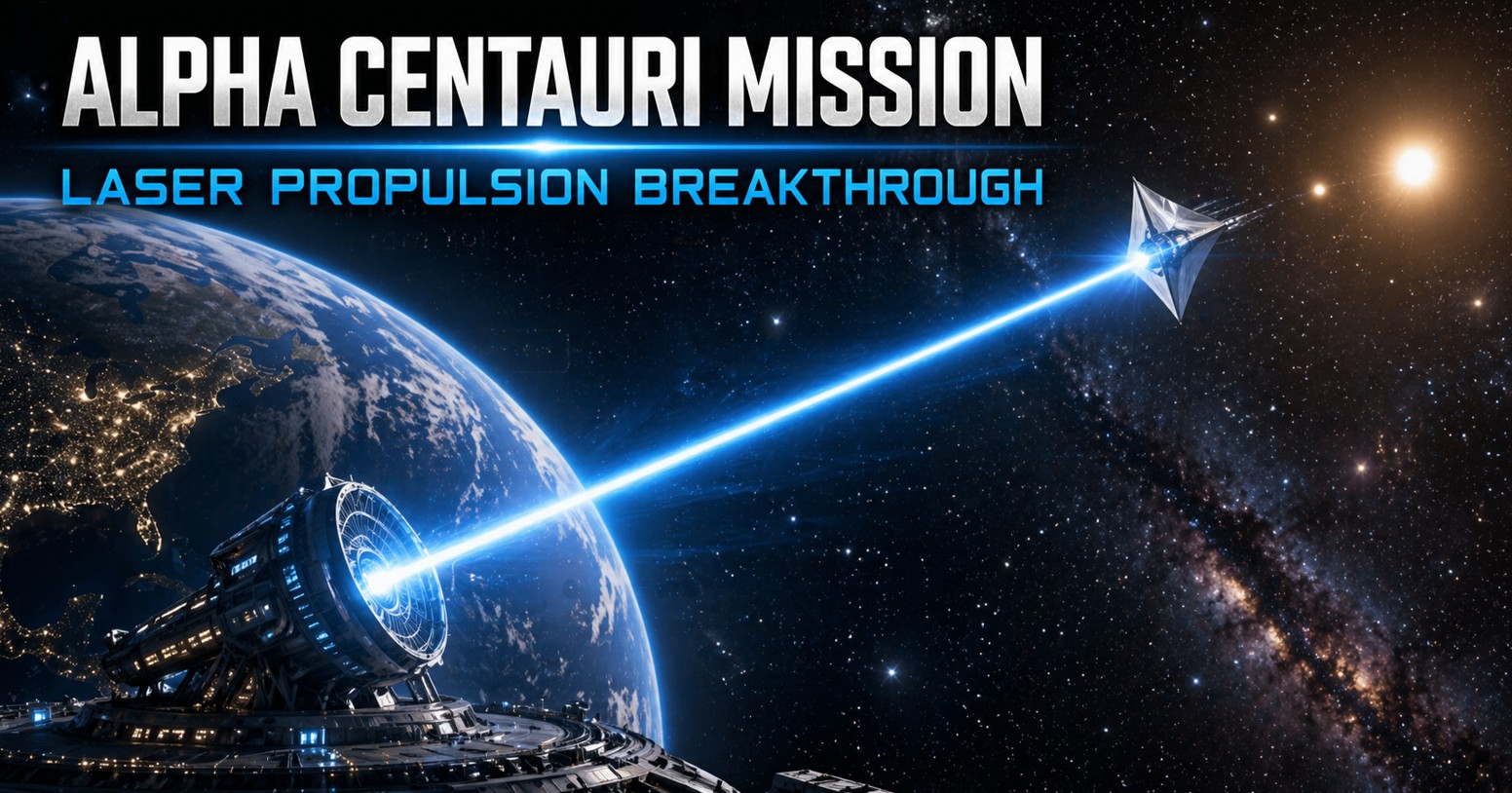
Humanity has always looked toward the stars with curiosity and ambition. Among all nearby star systems, Alpha Centauri stands out as the closest neighbor to our solar system, located about 4.37 light-years away. However, reaching it using current rocket technology would take tens of thousands—or even hundreds of thousands—of years.
This limitation has pushed scientists to explore revolutionary propulsion technologies. One of the most promising concepts is laser propulsion, particularly highlighted in recent studies focusing on Alpha Centauri missions. These studies suggest that by using powerful laser systems, spacecraft could reach nearby stars within a human lifetime.
In this article, we’ll explore the Alpha Centauri laser propulsion study, how it works, recent breakthroughs, challenges, and what it means for the future of space exploration.
What Is Laser Propulsion?
Laser propulsion is a form of beam-powered propulsion, where energy is delivered to a spacecraft from an external source—typically a powerful laser—rather than carrying fuel onboard.
Instead of burning chemical fuel like traditional rockets, laser propulsion uses light (photons) to generate thrust.
How It Works
- A powerful laser beam is directed at a spacecraft
- The light transfers momentum to the spacecraft
- This pushes the spacecraft forward without fuel
- Continuous laser exposure leads to acceleration
This concept is based on a simple physical principle: light carries momentum. When photons hit a surface, they exert a small force. Over time, especially in space where there is no friction, this force can significantly accelerate an object
Why Alpha Centauri?
Alpha Centauri is the closest star system to Earth and is a prime candidate for interstellar exploration.
Key Facts
- Distance: ~4.37 light-years
- Contains three stars:
- Alpha Centauri A
- Alpha Centauri B
- Proxima Centauri
- Potentially habitable exoplanets exist
Because of its proximity and scientific importance, Alpha Centauri has become the main target for advanced propulsion research.
The Problem with Traditional Space Travel
Current propulsion systems rely on:
- Chemical rockets
- Ion propulsion
- Nuclear concepts (theoretical)
However:
- These require massive fuel loads
- They have limited speed
- They cannot realistically reach nearby stars in reasonable time
In fact, studies show that traditional propulsion could take hundreds of thousands of years to reach Alpha Centauri
The Alpha Centauri Laser Propulsion Study (Latest Breakthrough)
Recent research from Texas A&M University has introduced a breakthrough concept using laser-driven “metajets.”
What Are Metajets?
Metajets are:
- Microscopic structures
- Built with special materials called metasurfaces
- Designed to interact with light in controlled ways
When a laser beam hits these structures:
- Light is redirected
- Momentum is transferred
- The object moves in controlled directions
This allows:
- Forward motion
- Side movement
- Full 3D maneuverability
This is a major advancement because earlier systems lacked control.
Key Achievement
Scientists demonstrated that:
- Objects can be lifted and steered using only light
- No physical contact is required
- Motion can be controlled precisely
This is the first time full 3D optical propulsion control has been demonstrated
How Fast Could We Reach Alpha Centauri?
One of the most exciting aspects of this study is its implication for travel time.
Researchers estimate that:
- Laser propulsion could enable travel to Alpha Centauri in about 20 years
Compare that with:
| Method | Time to Alpha Centauri |
|---|---|
| Chemical rockets | 50,000+ years |
| Ion propulsion | Tens of thousands of years |
| Laser propulsion | ~20 years |
This represents a massive leap in capability.
Breakthrough Starshot: A Real-World Application
One of the most famous projects related to laser propulsion is:
👉 Breakthrough Starshot
Project Overview
- Launched in 2016
- Backed by scientists and investors
- Budget: ~$100 million initial funding
- Goal: Send tiny spacecraft to Alpha Centauri
How It Works
- Uses a 100 GW laser array
- Pushes ultra-light spacecraft (gram-scale)
- Accelerates them to ~20% speed of light
- Travel time: ~20 years
Advantages of Laser Propulsion
1. No Fuel Required
Traditional spacecraft carry fuel, increasing mass. Laser propulsion eliminates this.
2. Extremely High Speed
Laser propulsion can theoretically reach relativistic speeds (fraction of light speed).
3. Continuous Acceleration
As long as the laser is active, the spacecraft keeps accelerating.
4. Lower Weight Spacecraft
Without fuel, spacecraft can be smaller and cheaper.
Technical Challenges
Despite its promise, laser propulsion faces major challenges:
1. Power Requirements
- Requires extremely powerful lasers
- Current technology is not yet sufficient
2. Precision Targeting
- Laser must hit a tiny spacecraft across vast distances
- Even slight misalignment can cause failure
3. Material Limitations
- Spacecraft must withstand:
- Extreme heat
- Radiation
- High acceleration forces
4. Deceleration Problem
- How do you slow down when you reach the destination?
- Current solutions include:
- Magnetic sails
- Electric sails
Other Related Laser Propulsion Concepts
Project Dragonfly
- Designed to reach Alpha Centauri within 100 years
- Uses laser-powered sails
Project Starlight
- Uses laser beams to accelerate spacecraft
- Could reach Alpha Centauri in decades
The Science Behind It: Photon Momentum
The physics behind laser propulsion is based on:
👉 Momentum transfer from photons
When light hits a surface:
- It reflects
- Transfers momentum
- Creates a tiny force
Though small individually, billions of photons create measurable thrust.
Researchers compare it to:
👉 “Ping pong balls bouncing off a surface”
Why This Study Matters
The Alpha Centauri laser propulsion study is important because:
- It proves controlled motion using light
- It opens doors to interstellar travel
- It reduces dependency on fuel
- It enables faster missions
Most importantly:
👉 It moves interstellar travel from science fiction toward reality
Future Possibilities
If laser propulsion becomes practical, we could:
1. Explore Nearby Star Systems
- Alpha Centauri
- Proxima Centauri planets
2. Search for Alien Life
- Detect biosignatures
- Analyze atmospheres
3. Build Interstellar Communication Systems
- Laser-based communication networks
4. Enable Human Interstellar Travel (Long-term)
Though currently unrealistic, future advancements may make it possible.
Limitations of Current Research
Despite breakthroughs, current experiments:
- Are done on microscopic scales
- Require massive scaling
- Need funding and infrastructure
Even the Breakthrough Starshot project has faced funding challenges and delays
Conclusion
The Alpha Centauri laser propulsion study represents one of the most exciting developments in modern space science. By using lasers to propel spacecraft, scientists are redefining the limits of exploration.
While challenges remain, the potential is enormous:
- Travel to another star in decades
- Fuel-free propulsion systems
- New era of space exploration
In the coming decades, laser propulsion could transform humanity from a planetary species into an interstellar one.
🚀 Want to Discover More Space Innovations?
Explore our latest articles on future technology, space science, and breakthrough discoveries.
Frequently Asked Questions
How long would it take to reach Alpha Centauri using laser propulsion?
Scientists estimate that laser propulsion could enable travel to Alpha Centauri in around 20 years.
What is laser propulsion in simple terms?
Laser propulsion uses powerful light beams to push a spacecraft forward instead of traditional fuel.
Is Alpha Centauri habitable?
Some planets in the Alpha Centauri system may have conditions suitable for life, but more research is needed.